
2026-2027 Alan D. Leve Center Talks
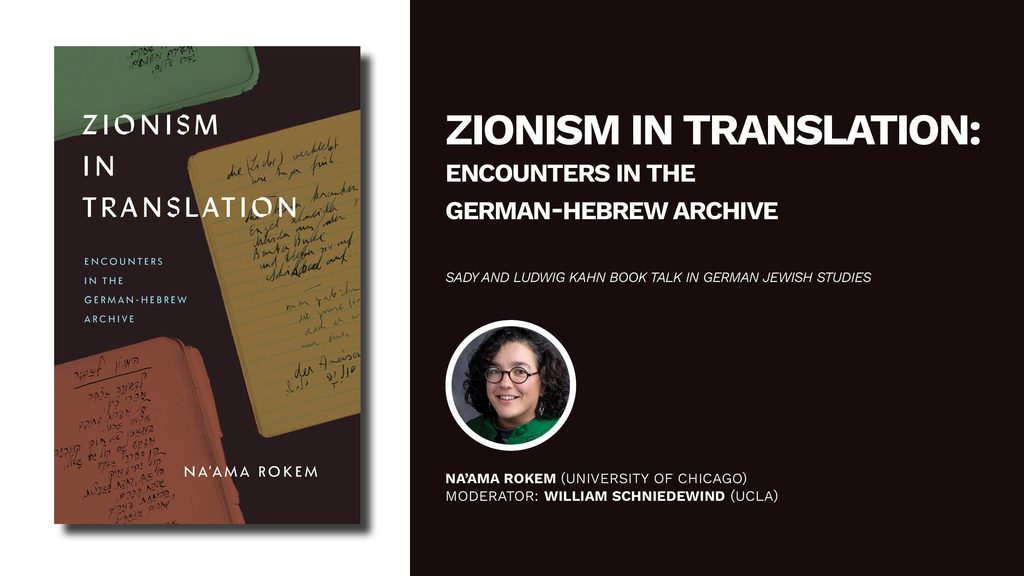
Zionism in Translation: Encounters in the German-Hebrew Archive
Na’ama Rokem (University of Chicago) Moderator: William Schniedewind (UCLA)
October 1, 2026
Zionism in Translation examines German- and Hebrew-language correspondence among prominent Jewish writers and thinkers, including Hannah Arendt, Gershom Scholem, Walter Benjamin, Leah Goldberg, Paul Celan, and Yehuda Amichai, in the decades surrounding 1948. In the aftermath of the Holocaust and amid the founding of Israel and the Palestinian Nakba, these figures confronted the changing relationship between German and Hebrew while debating Jewish identity, nationalism, Zionism, and the possibilities of Jewish poetry. Rokem argues that writing across these two languages created a unique space for expressing uncertainties and ambivalence about Jewish fate, culture, and politics in the twentieth century.
Sady and Ludwig Kahn Book Talk in German Jewish Studies
2025-2026 Alan D. Leve Center Talks

Happy Jews in the Roman Diaspora? The Case of Asia Minor (Anatolia)
Seth Schwartz (Columbia) Moderator: Catherine Bonesho (UCLA)
June 2, 2026
A dominant trend in scholarship about Jews in the Roman Imperial diaspora emphasizes the Jews’ achievement of a successful balance between integration and separation, and regards this happy equilibrium as essentially stable for centuries. I will argue that this view rests on a fundamental misreading of the sources. Asia Minor (modern Turkey) provided the richest evidence for the dominant view but when disentangled tells a story of conflict, instability and, above all, poverty. This rather gloomy picture changed for the better only in the fourth century CE, before a steady decline starting in the fifth.
Etta and Milton Leve Scholar in Residence Lecture

Jews and Godfearers: Sardis and Aphrodisias, 400 CE
Seth Schwartz (Columbia) Moderator: Carol Bakhos (UCLA)
June 3, 2026
The phenomenon of “Godfearing”—adoption by gentiles, usually supposed to have been pagan—of Jewish practices including support for local Jewish communities and attendance in synagogues—has loomed larger in scholarship than it does in the sources. But the phenomenon surely existed. Some ancient writers suggest that in the first century most diaspora jewish communities had a “fringe” of gentile sympathizers who functioned for Jewish communities as protectors and mediators with local governments. Godfearing comes to the fore again in major texts of the early fifth century CE. How much of the traditional picture can be salvaged? (Spoiler: some) How continuous was fifth-century Godfearing with first-century Godfearing? (Second spoiler: not very).
Etta and Milton Leve Scholar in Residence Seminar

The Past, Present, and Future of Jews and the Labor Movement in Los Angeles
May 28, 2026
Rabbi Aryeh Cohen (Professor, American Jewish University)
Maya Barron-Jones (UFCW Local 770)
Jackie Goldberg (retired educator and elected official)
Leora Swerdlow (Associate, Schwartz, Steinsapir, Dohrmann & Sommers LLP)
Moderated by Brian Dolber (Associate Professor of Communication and Media Studies, California State University, San Marcos)
Sponsored by The UCLA Labor Center, The UCLA Alan D. Leve Center for Jewish Studies, Jewish Partnership for Los Angeles, The Jewish Labor Committee, LA Voice, UFCW Local 770, and UNITE HERE Local 11

Biblical Monotheism: Exclusive or Inclusive?
Ben Sommers (Jewish Theological Seminary) Moderator: William Schniedewind
May 7, 2026
This lecture examined the discussion of pluralism in the field of comparative theology in light of a core question in the history of Israelite religion. It will create a dialogue between the work of historians of religion such as Yehezkel Kaufmann and theologians such as John Hick, with some reference to the Egyptologist Jan Assmann, moving from a close reading of passages in Deuteronomy, Psalms, and Isaiah to much broader theological issues.
The Bible and the Ancient World Seminar Series

Jewish Anti-Zionism as Political Theology: The Major Writings of Rabbi Yoel Teitelbaum
Shaul Magid (Harvard Divinity School) Respondents: Leah Hochman (Hebrew Union College), David N. Myers (UCLA), & Joshua Shanes (UC Davis)
April 29, 2026
Rabbi Yoel Teitelbaum of Satmar, one of the most celebrated Hasidic masters of the twentieth century, is known not only for founding the world’s largest Hasidic dynasty, but also for his strongly held anti-Zionist views. His work articulates a Jewish political theology against Zionism built on the foundations of traditional Jewish sources, and its influence remains strong within the ultra-Orthodox Satmar community and beyond. Dense with references to rabbinic, medieval, and modern sources, Teitelbaum’s writing is notoriously challenging even for scholars of Torah to parse. In this volume, Shaul Magid provides a richly annotated translation of selections from the books Vayoel Moshe and ‘Al Ha-Geulah ve ‘al Ha-Temurah, making Teitelbaum’s major political writings accessible to English-speaking readers for the first time.
Book Talk
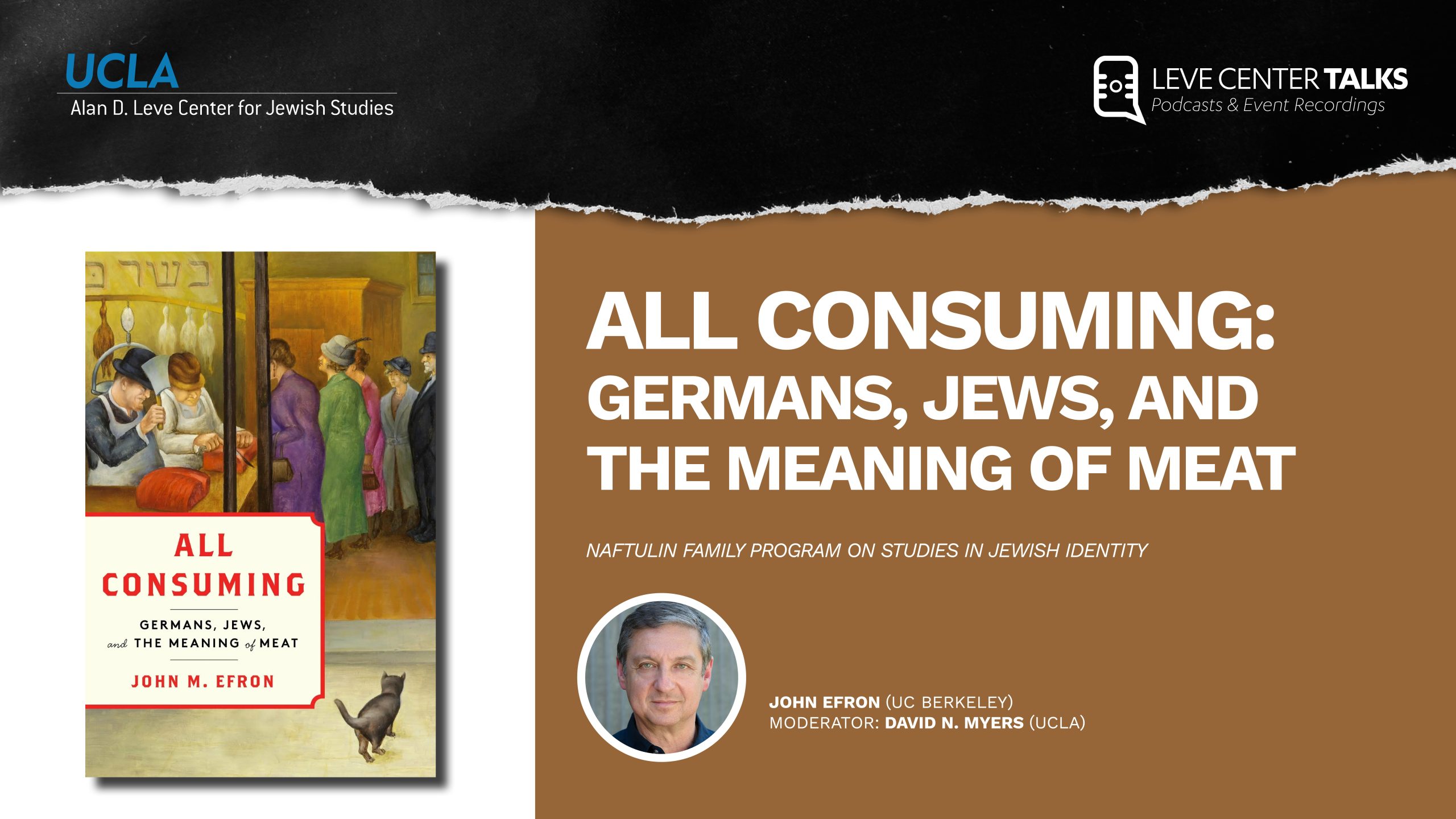
All Consuming: Germans, Jews, and the Meaning of Meat
John Efron (UC Berkeley) Moderator: David N. Myers (UCLA)
April 28, 2026
Meat is one of the most visible markers of Jewish distinctness and social separation. In his most recent book, John Efron argues that meat has played an especially important role in the formation of Jewish and Christian identities in Germany from the Middle Ages until today. To an extent not seen elsewhere in Europe, the importance of meat is reflected in many realms including the visual arts, literature, religion, politics, commerce, and home life. Studying the history of meat and its multiple meanings in Germany tells us much about the changing nature of German and German-Jewish identity, as well as the links between religion, nationality, politics, and food. Above all, focusing on meat provides us with a singular window into the rich, fraught, and ultimately tragic history of German Jewry.
Naftulin Family Program on Studies in Jewish Identity
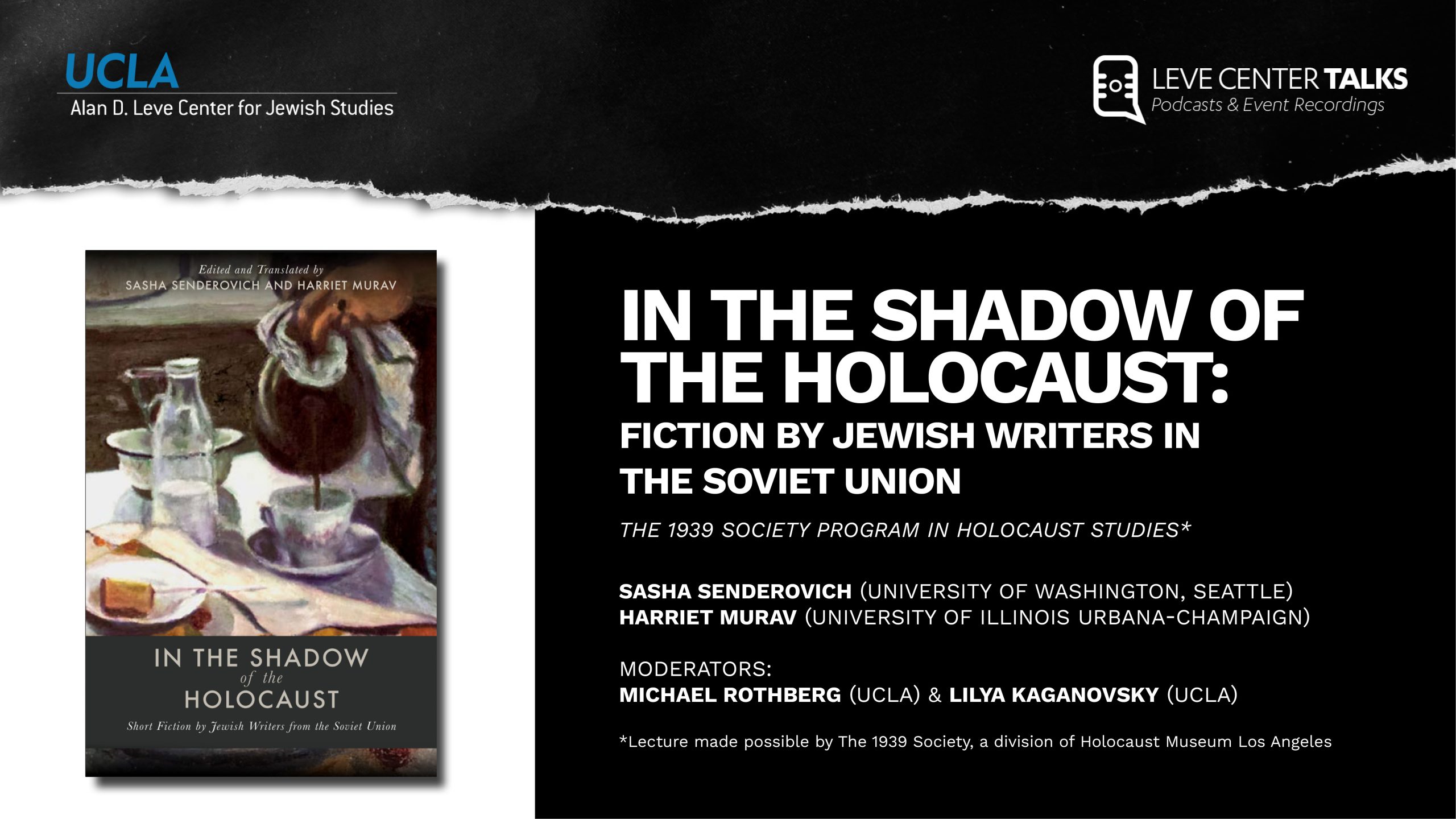
In the Shadow of the Holocaust: Short Fiction by Jewish Writers from the Soviet Union
Sasha Senderovich (University of Washington, Seattle) & Harriet Murav (University of Illinois Urbana-Champaign)
Moderators: Michael Rothberg (UCLA) & Lilya Kaganovsky (UCLA)
April 21, 2026
The short fiction collected in In the Shadow of the Holocaust recovers a range of compelling voices that had been scarcely known or translated. Jewish authors from Ukraine, Lithuania, Russia, and Belarus, some writing in Yiddish and others in Russian, tell the stories of ordinary people living on after the massive devastation of the Holocaust on Soviet territory, depicting memories, conflicts, love, and loss. These are not stories only about how people died, but how they continued to live: an entire family legacy is reduced to a single tea cup, the now raspy voice of a telephone that once never stopped ringing, and a train timetable that lists key places of Jewish life largely destroyed but still vital. Translated by Sasha Senderovich and Harriet Murav, these stories provide new perspectives on questions fundamental to literature of the Holocaust and legacies of other genocides and mass violence.
The 1939 Society Program in Holocaust Studies. Lecture made possible by The 1939 Society, a division of Holocaust Museum Los Angeles
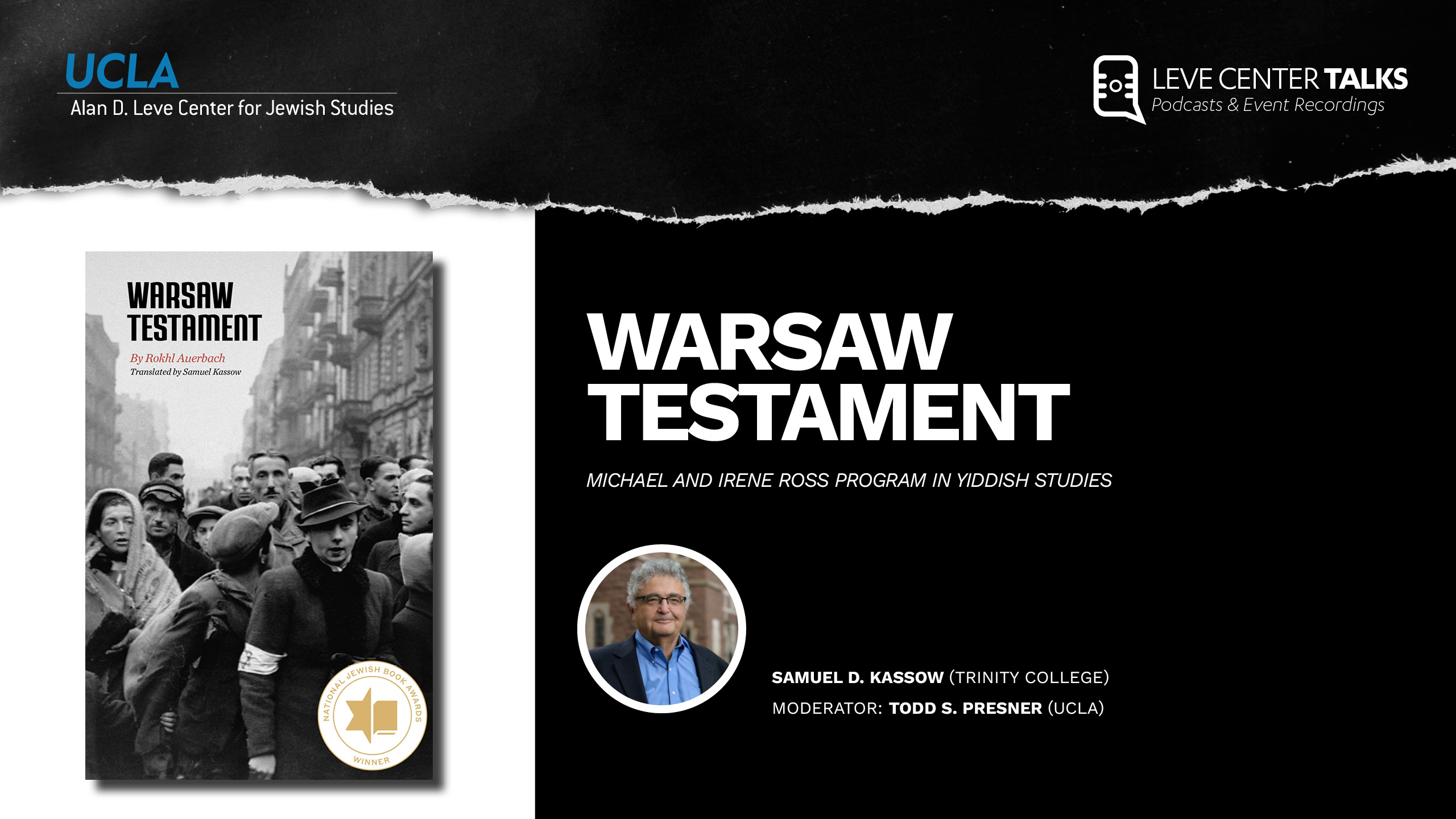
Warsaw Testament
Samuel D. Kassow (Trinity College) Moderator: Todd S. Presner (UCLA)
March 12, 2026
Until recently, very few people knew about Rokhl Auerbach, a remarkable woman who survived the Holocaust and then dedicated her life to preserving the memories of its victims. Professor Samuel D. Kassow will discuss Auerbach’s memoir Warsaw Testament, which paints a vivid portrait of that city’s prewar Yiddish literary and artistic community atruction at the hands of the Nazis. This book received a National Jewish Book Award in the category of Holocaust Memoir.
Michael and Irene Ross Program in Yiddish Studies
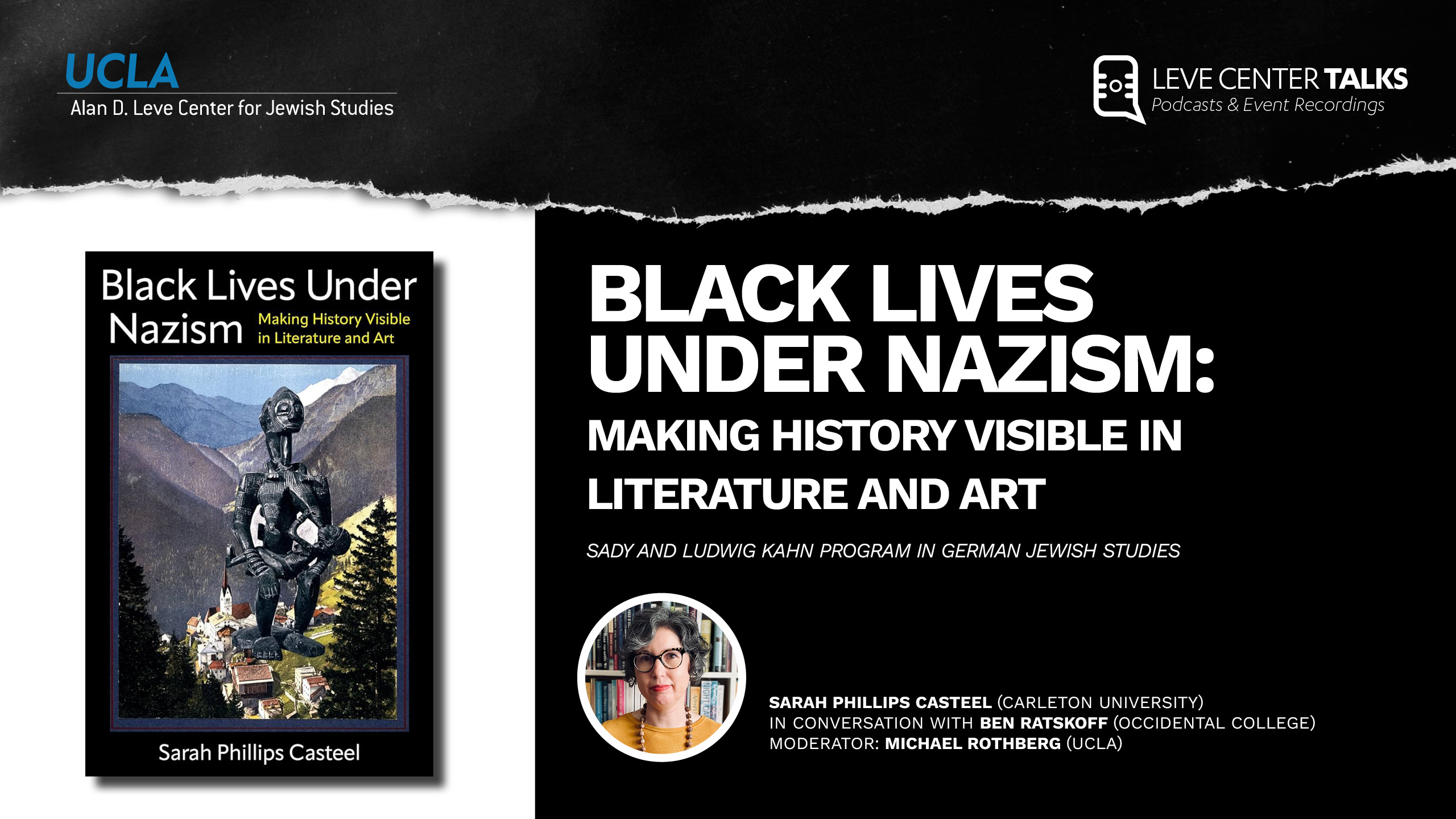
Black Lives Under Nazism: Making History Visible in Literature and Art
Sarah Phillips Casteel (Carleton University) in conversation with Ben Ratskoff (Occidental College) Moderator: Michael Rothberg (UCLA)
March 16, 2026
In a little-known chapter of World War II, Black people living in Nazi Germany and occupied Europe were subjected to ostracization, forced sterilization, and incarceration in internment and concentration camps. In the absence of public commemoration, Black writers and visual artists have preserved the stories of these forgotten victims of the Third Reich. Their works of memoir, poetry, fiction, painting and photomontage illuminate both the relationship between creativity and wartime survival and the role of art in the formation of collective memory. Probing the boundaries of Holocaust memory and representation, this talk draws attention to a largely unrecognized artistic corpus that challenges the erasure of Black wartime history.
Sady and Ludwig Kahn Lecture in German Jewish Studies
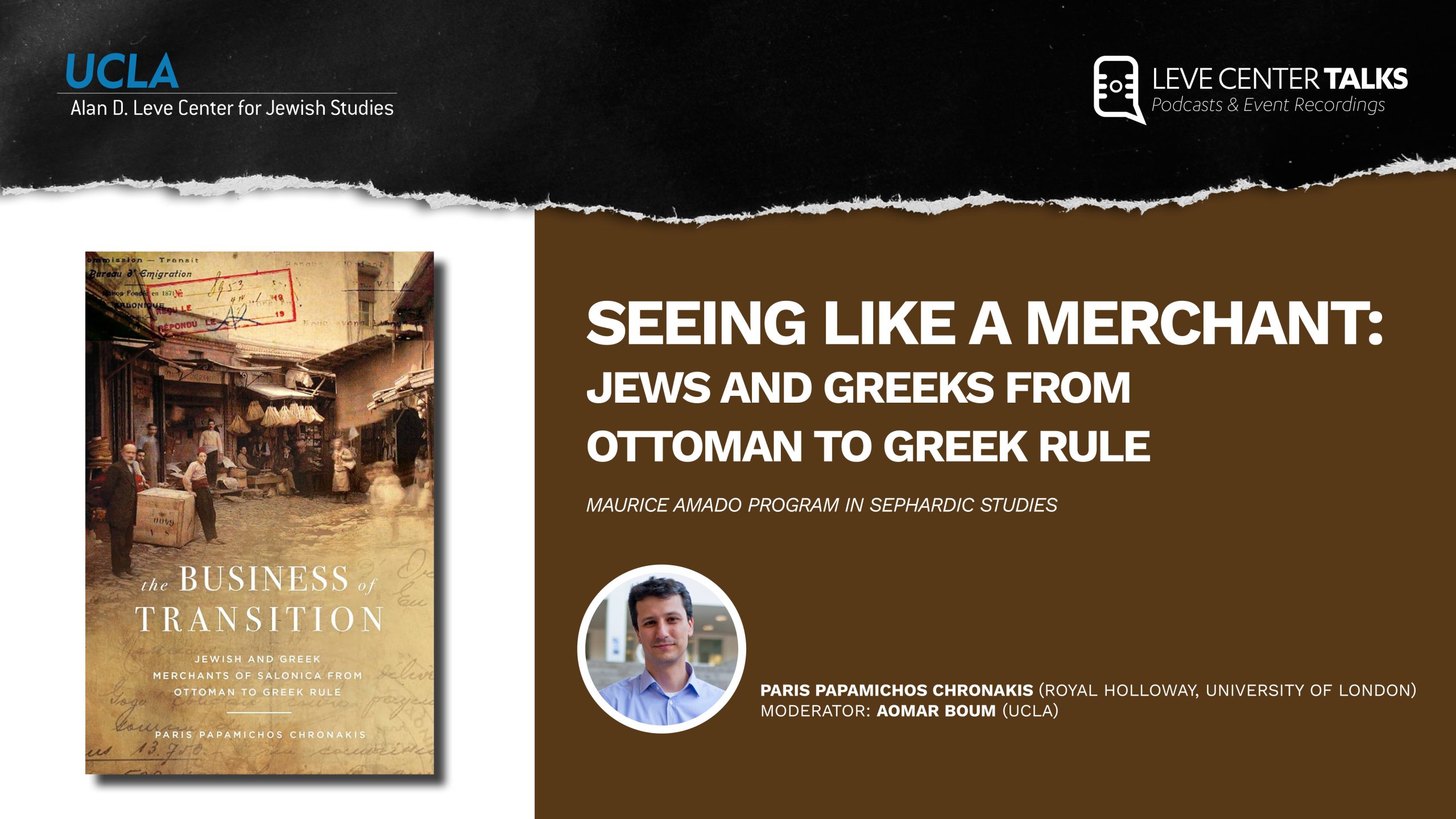
Seeing Like a Merchant: Jews and Greeks from Ottoman to Greek Rule
Paris Papamichos Chronakis (Royal Holloway, University of London) Moderator: Aomar Boum (UCLA)
February 24, 2026
How did the cosmopolitan bourgeoisie of the Eastern Mediterranean navigate the transition from empire to nation-state in the early twentieth century? In this talk, Paris Papamichos Chronakis shows how the Jewish and Greek merchants of Salonica (present-day Thessaloniki) skillfully managed the tumultuous shift from Ottoman to Greek rule amidst rising ethnic tensions and heightened class conflict. Bringing their once powerful voices back into the historical narrative, he traces their entangled trajectories as businessmen, community members, and civic leaders to illustrate how the self-reinvention of a Jewish-led bourgeoisie made a city Greek. Salonica’s merchants were present in their own—and their city’s—remaking.
Maurice Amado Program in Sephardic Studies
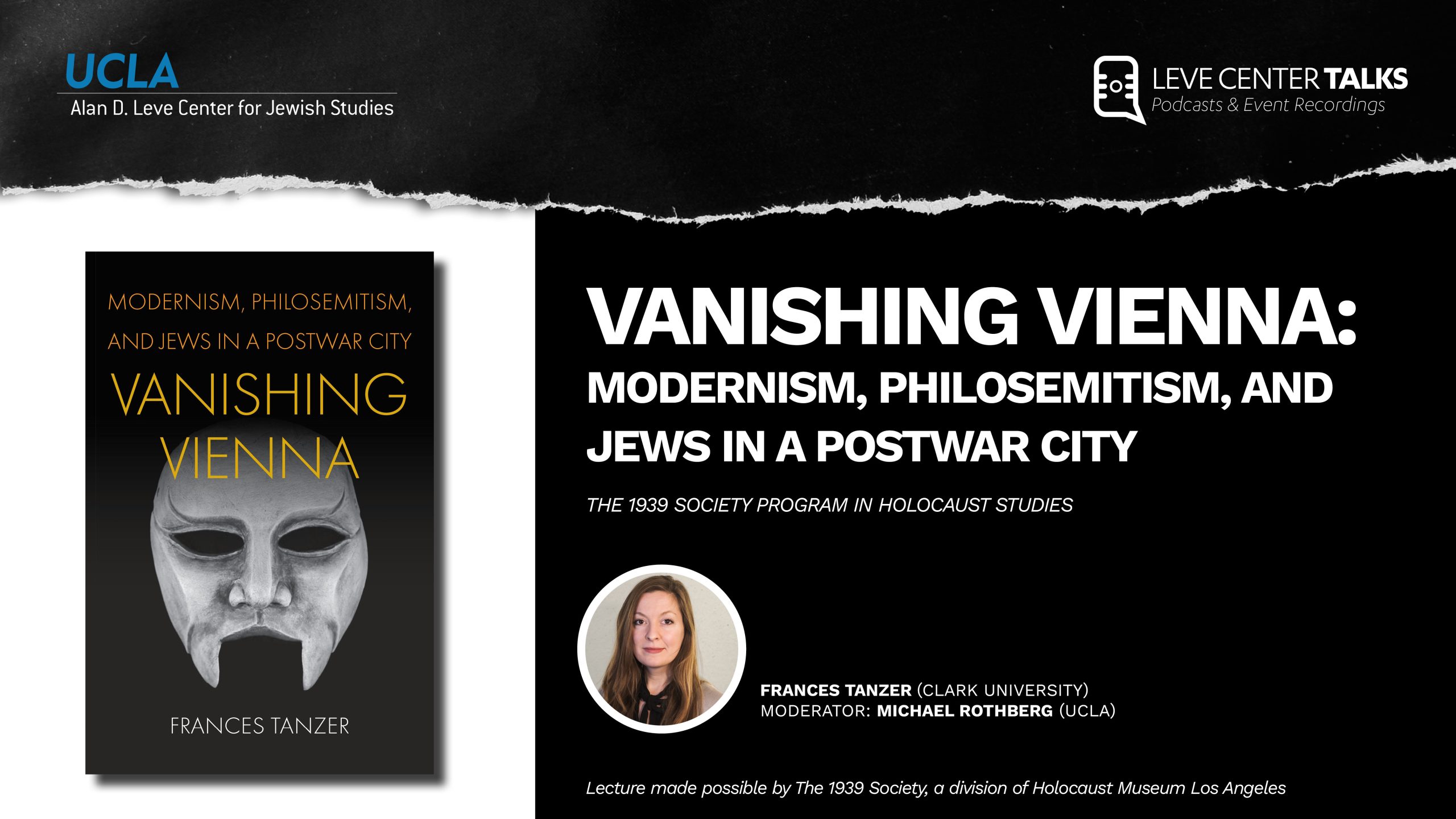
Vanishing Vienna: Modernism, Philosemitism, and Jews in a Postwar City
Frances Tanzer (Clark University) Moderator: Michael Rothberg (UCLA)
February 19, 2026
Frances Tanzer will discuss her new book, Vanishing Vienna: Modernism, Philosemitism, and Jews in a Postwar City (University of Pennsylvania Press), which traces the reconstruction of Viennese culture from the 1938 German Anschluss through the early 1960s. The book reveals continuity in Vienna’s cultural history across this period: a framework for interpreting Viennese culture that has relied on antisemitism, philosemitism, and a related discourse of Jewish presence and absence. As she shows, antisemitism and philosemitism were not contradictory forces in post-Nazi Austrian culture. They were deeply interconnected aspirations in a city where nostalgia for the past dominated cultural reconstruction efforts and supported seemingly contradictory impulses. Philosemitism was much more than a simple inversion of antisemitism—instead, Tanzer argues, philosemitism defined Vienna in the era of postwar reconstruction. Vanishing Vienna uncovers a rarely discussed phenomenon of the immediate aftermath of the Holocaust—a society that consumes, redefines, and bestows symbolic meaning on the victims in their absence.
The 1939 Society Program in Holocaust Studies. Lecture made possible by The 1939 Society, a division of Holocaust Museum Los Angeles

Multilingualism and Translation in Ancient Judaism: Before and After Babel
Steven D. Fraade (Yale University) Moderator: William Schniedewind (UCLA)
February 10, 2026
Steven Fraade explores the practice and conception of multilingualism and translation in ancient Judaism. Interrogating the deep and dialectical relationship between them, he situates representative scriptural and other texts within their broader synchronic – Greco-Roman context, as well as diachronic context – the history of Judaism and beyond. Neither systematic nor comprehensive, his selection of Hebrew, Aramaic, and Greek primary sources, here fluently translated into clear English, best illustrate the fundamental issues and the performative aspects relating to translation and multilingualism. Fraade scrutinizes and analyzes the texts to reveal the inner dynamics and the pedagogical-social implications that are implicit when multilingualism and translation are paired. His book demonstrates the need for a more thorough and integrated treatment of these topics, and their relevance to the study of ancient Judaism, than has been heretofore recognized.
The Bible and the Ancient World Seminar Series

Antisemitism, an American Tradition
Pamela Nadell (American University) Moderator: Dov Waxman (UCLA)
February 5, 2026
In Antisemitism, an American Tradition Pamela S. Nadell, the Patrick Clendenen Chair in Women’s and Gender history at American University, recounts the powerful story of antisemitism in America and how it has shaped the lives of Jews for almost four centuries. Indeed, Jews have met antisemitism since first landing in New Amsterdam in 1654 when Peter Stuyvesant tried to expel them. The founding of the US changed little, as negative European stereotypes rooted into American soil. They faced restrictions on holding office, admission to schools, and employment in industry, while their synagogues and cemeteries were vandalized. Recently, white nationalists chanted “Jews will not replace us” in Charlottesville, Virgina, and a gunman killed eleven members at Pittsburgh’s Tree of Life synagogue building. Antisemitic incidents have increased each year.
Lecture in American Jewish Studies
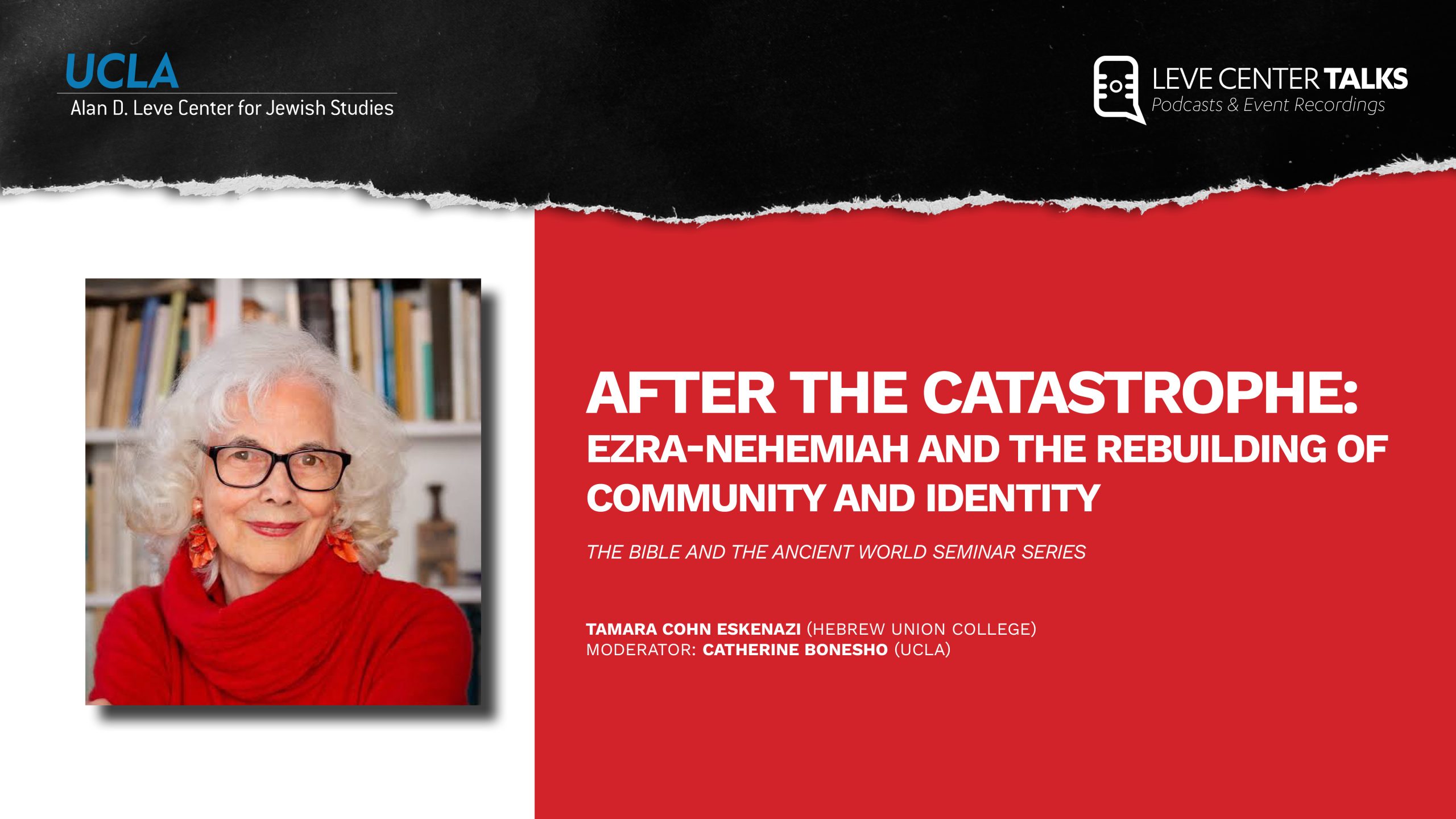
After the Catastrophe: Ezra-Nehemiah and the Rebuilding of Community and Identity
Tamara Cohn Eskenazi (Hebrew Union College) Moderator: Catherine Bonesho (UCLA)
January 29, 2026
The deaths and deportations that accompanied the destruction of the Jerusalem by the Babylonians in 587 BCE mark the turning point in the arc of biblical narrative. The book of Ezra-Nehemiah describes the reconstruction of life in Judah in the aftermath that catastrophe. It is the only book in the Hebrew Bible to depict this formative period. For over a century, scholars neglected Ezra-Nehemiah and the period it describes. But the pendulum swung at last, and in recent decades the book became a focal point for several reasons. Detractors and admirers alike concur that its messages had an enduring significance in the past and important messages for the present. This session will explore what the book contributed to the revival of communal life in an ancient homeland as well as its relevance to today’s challenges.
The Bible and the Ancient World Seminar Series
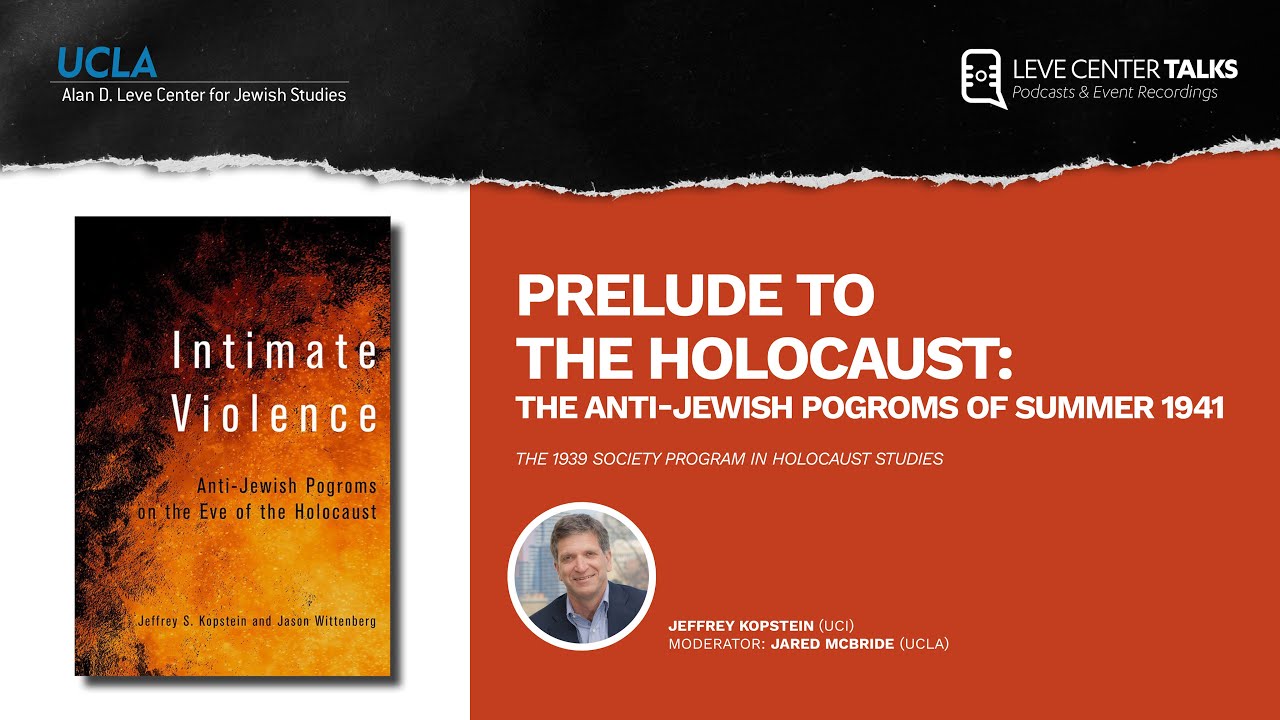
Prelude to the Holocaust: The Anti-Jewish Pogroms of Summer 1941
Jeffrey Kopstein (UCI) Moderator: Jared McBride (UCLA)
January 27, 2026
This lecture examines a particularly brutal wave a violence that occurred across hundreds of predominantly Polish and Ukrainian communities in the aftermath of the Nazi invasion of the Soviet Union. The dominant explanations for pogrom violence center around three most frequently cited causes: endemic antisemitism in Eastern European societies, a desire for revenge for alleged Jewish involvement in Soviet crimes during the occupation of 1939–1941, and opportunistic appropriation of Jewish property. But a difficult question needs to be posed: why did pogroms occur in some places and not in others? Situating pogroms within the long history of local intercommunal relations sheds light on the sources of mass ethnic violence and the ways in which such gruesome acts might be avoided.
The 1939 Society Program in Holocaust Studies
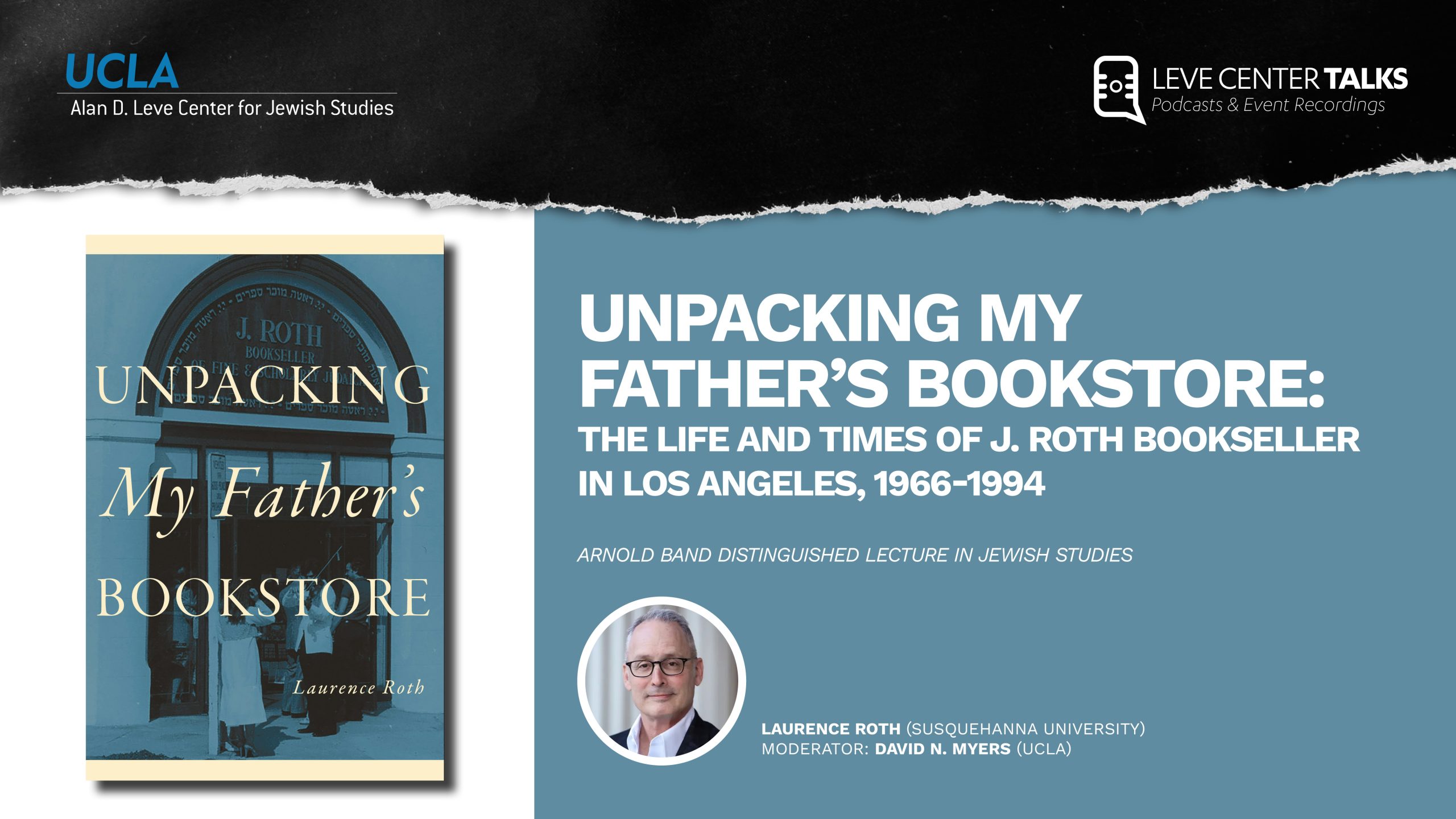
Unpacking my Father’s Book Store: The Life and Times of J. Roth Bookseller in Los Angeles, 1966-1994
Laurence Roth (Susquehanna University) Moderator: David N. Myers (UCLA)
December 9, 2025
For nearly thirty years, J. Roth / Bookseller of Fine & Scholarly Judaica reflected the diversity of Los Angeles Jewry and stood among the nation’s leading Jewish bookstores. It flourished during the ethnic pride movements of the 1960s–70s but declined as Orthodox Judaism grew and Jewish books were absorbed into big-box retailers in the 1980s–90s. Blending memoir and analysis, Laurence Roth shows how this store—and Jewish bookstores more broadly—shaped Jewish culture and community, despite often disappearing from historical view. His account offers a rare, personal, and analytical look at the outsized impact of an independent Jewish bookstore.
The Arnold Band Distinguished Lecture in Jewish Studies
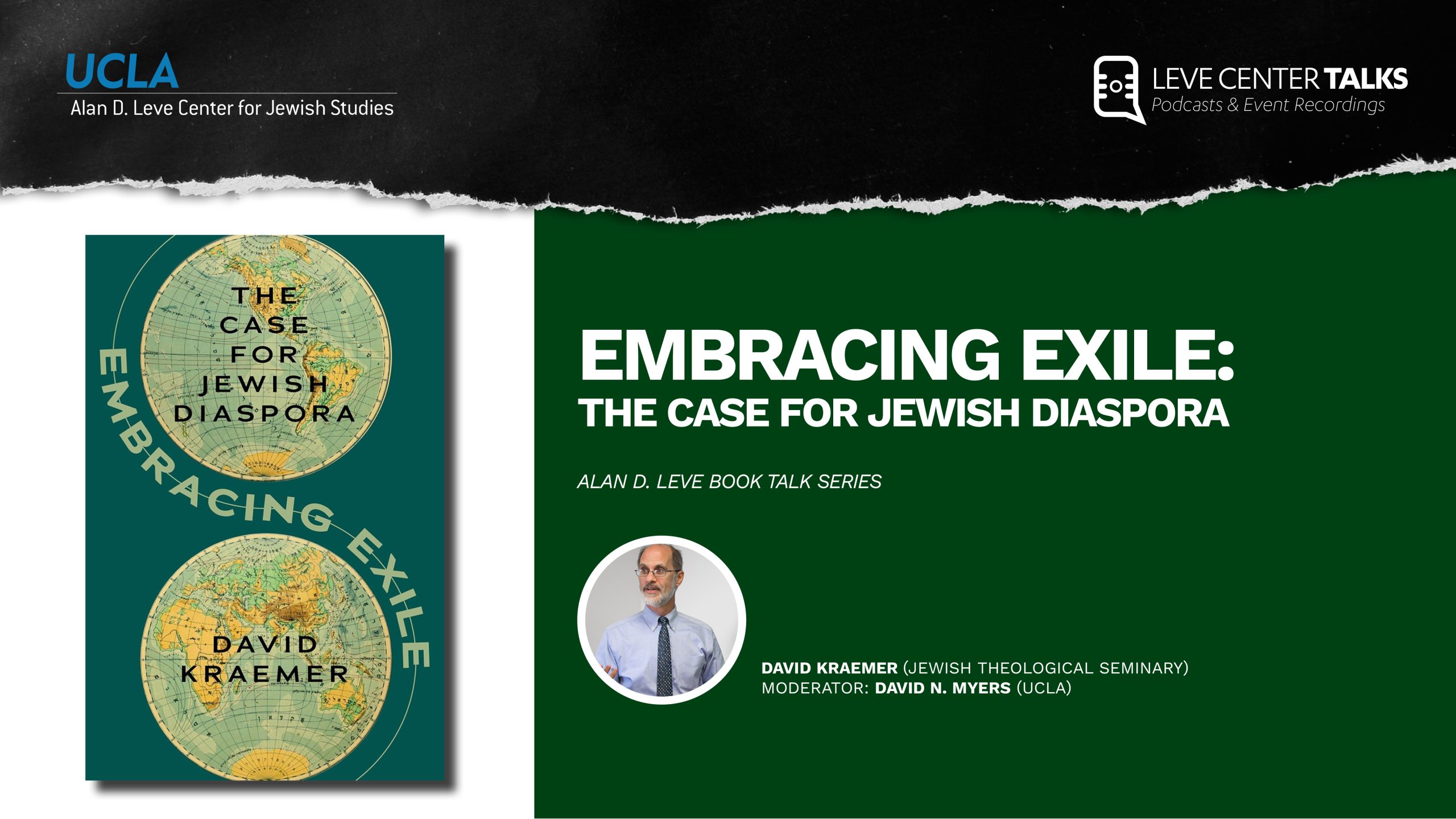
Embracing Exile: The Case for Jewish Diaspora
David Kraemer (Jewish Theological Seminary) Moderator: David N. Myers (UCLA)
December 4, 2025
Since the Babylonian Exile, diaspora has been the enduring Jewish condition. While hoping for an eventual return to their Promised Land, Jews throughout history found meaning in their dispersed homes, viewing exile as a place where religious life could thrive. Embracing Exile examines sources from antiquity to modernity to show that Jews believed God accompanied them wherever they lived and that “Zion” could be found in many lands. It argues that Jewish responses to exile were often creative and adaptive rather than mournful, and that Zionism is not an inevitable outgrowth of Jewish thought or history.
Alan D. Leve Book Talk Series
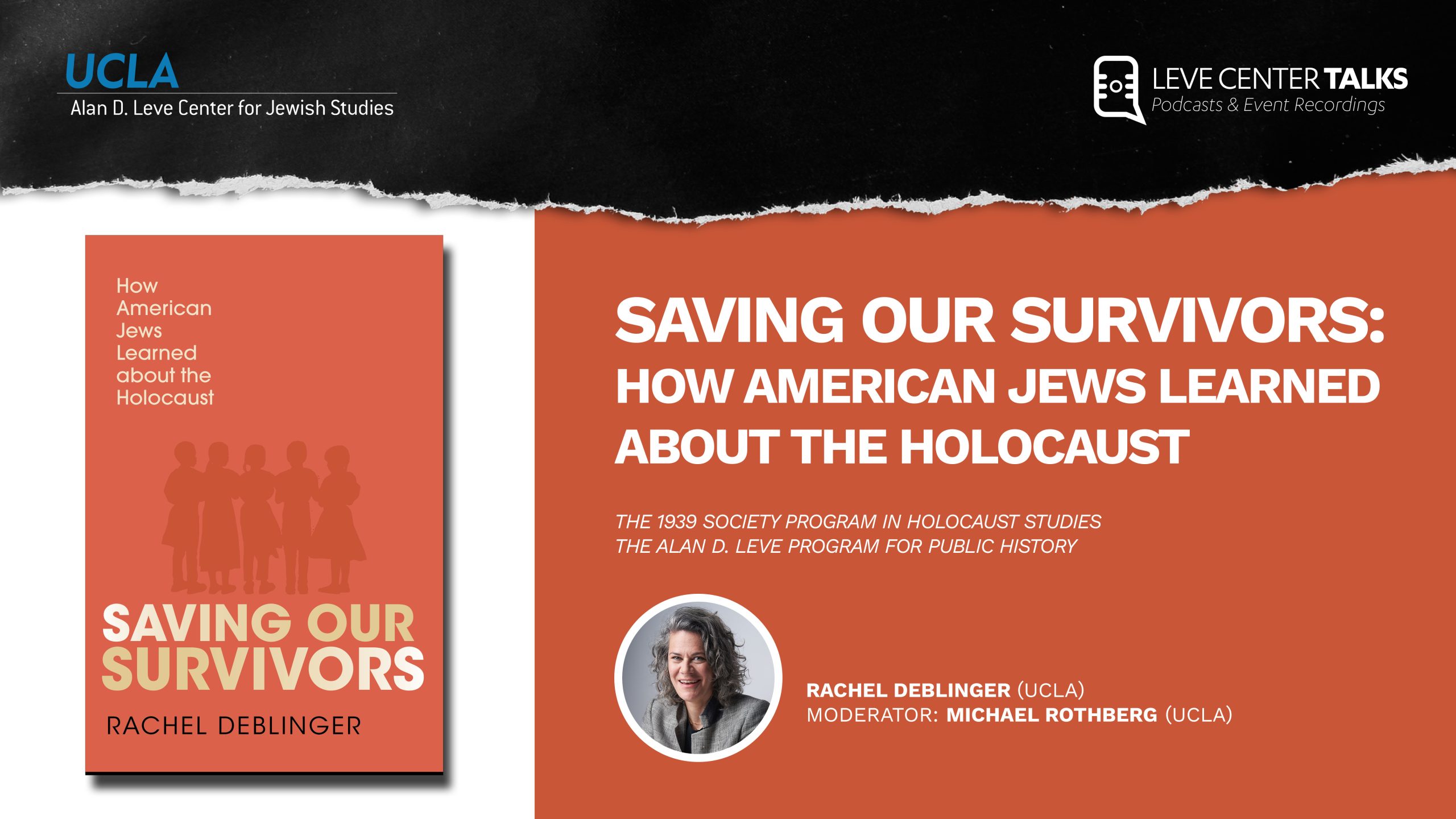
Saving our Survivors: How American Jews Learned about the Holocaust
Rachel Deblinger (UCLA) Moderator: Michael Rothberg (UCLA)
November 18, 2025
Drawing on previously unexamined archives and postwar cultural materials, Saving Our Survivors explores how American Jews constructed meaning out of devastation—and how humanitarian aid became intertwined with public memory. The book uncovers how American Jewish communities first came to learn about and respond to the Holocaust through communal campaigns, radio broadcasts, speeches, short films, and urgent calls to action. Rachel Deblinger highlights the messy, diffuse, and contested nature of memory construction in the immediate aftermath of the Holocaust and raises larger questions about how historical tragedies are narrated in moments of crisis.
The 1939 Society Program in Holocaust Studies
The Alan D. Leve Program for Public History
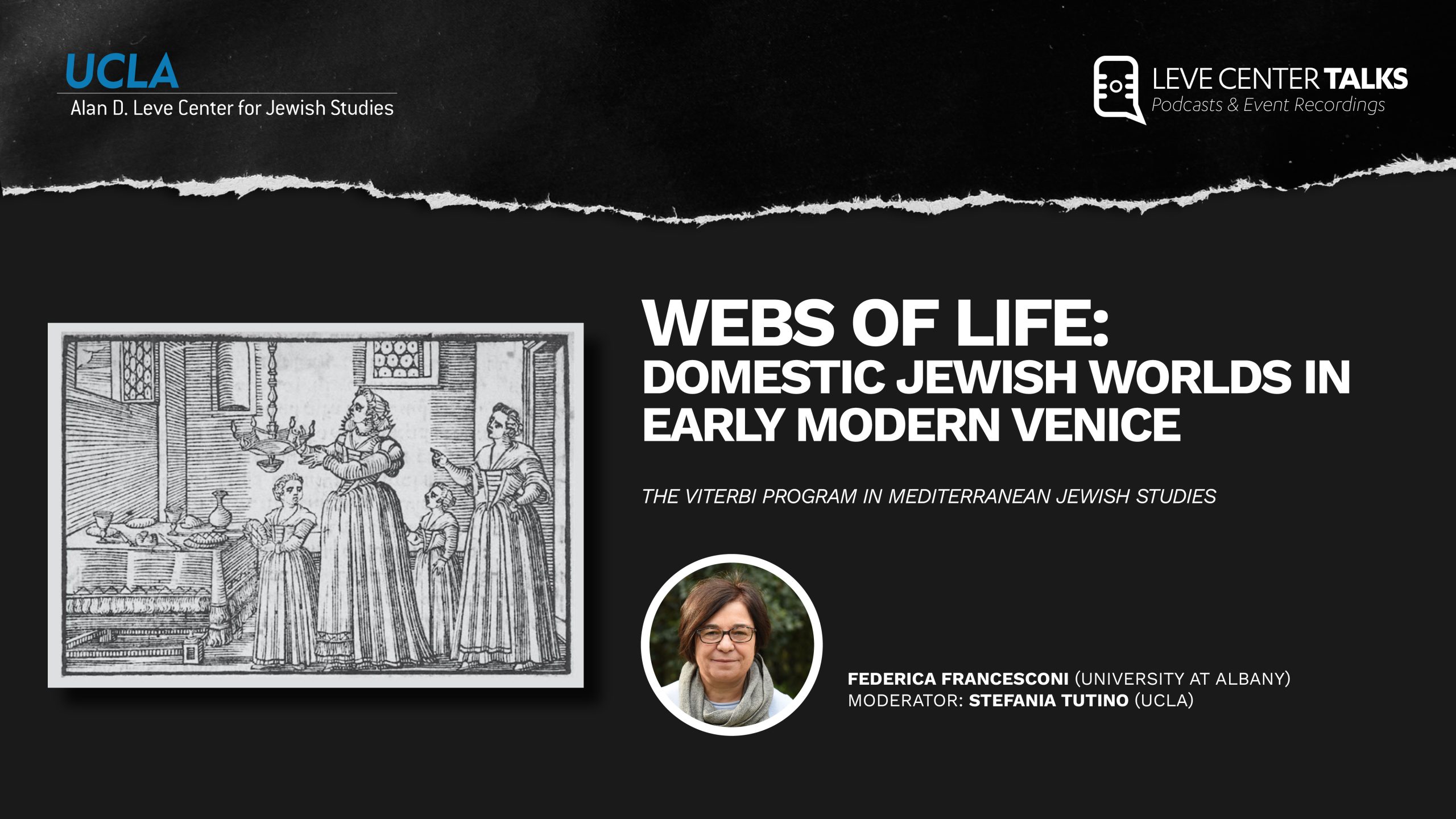
Webs of Life: Domestic Jewish Worlds in Early Modern Venice
Federica Francesconi (University at Albany) Moderator: Stefania Tutino (UCLA)
October 28, 2025
The lecture examines domestic life in the Venetian ghetto as both a constrained space shaped by segregation and a vibrant site of cultural exchange. Using archival evidence, material objects, and architectural analysis, it shows how Jews actively fashioned their homes—through features like the portego, Islamic carpets, and gilt leather panels—creating a blended aesthetic influenced by Jewish, Islamic, and Renaissance traditions. These choices reflect practical adaptation as well as lasting connections to memory, mobility, and diasporic identity. Ultimately, the lecture presents the ghetto home as a dynamic, multilayered network linking residents, objects, and spaces to the wider city and Mediterranean world.
The Viterbi Program in Mediterranean Jewish Studies

The Yiddish Supernatural on Screen: Dybbuks, Demons and Haunted Jewish Pasts
Rebecca Margolis (Monash University) Moderator: Todd Presner (UCLA)
October 21, 2025
This talk explored how Yiddish on screen extends beyond humor and nostalgia to convey themes of trauma, mysticism, and displacement. It examined how Yiddish reimagines Jewish lore, focusing on the dybbuk’s transformation from folklore to 1930s Polish Yiddish cinema and into contemporary global media. The discussion highlighted Yiddish as a mystical code within the horror genre and considered how immigrant and pre-immigrant pasts resurface in modern film and television.
The Michael and Irene Ross Program in Yiddish Studies